
Convert JSON to TypeScript Interfaces, Python Pydantic Models, and Go Structs
Instantly transform JSON payloads into type-safe code. Generates clean TypeScript interfaces, Python Pydantic models, Go structs, and Zod validation schemas.

Manually writing boilerplate type definitions, model classes, and validation schemas from complex JSON API responses is tedious, error-prone, and a common source of runtime bugs in web and backend development. A single misplaced optional property or incorrect type assumption can lead to undefined is not a function or unhandled deserialization crashes in production.
ShobFree's JSON to Types Converter inspects arbitrary JSON payloads and generates clean, production-ready code across 4 major programming ecosystems: TypeScript, Python (Pydantic), Go, and Zod Validation Schemas.
Quick answer
| Output Target | Framework / Ecosystem | Generated Output Syntax |
|---|---|---|
| TypeScript | React, Next.js, Node.js | Strict interface with recursive nested types |
| Python | FastAPI, Django, Flask | Modern Pydantic BaseModel classes with type hints |
| Go | Gin, Fiber, Standard Library | Idiomatic struct with \json:"field_name"\ tags |
| Zod Schema | Next.js Server Actions, tRPC | Runtime z.object({...}) validation schemas |
Step-by-step: How to convert JSON to type declarations
- Open the JSON to Types & Schema tool.
- Paste your raw JSON object or array into the left editor (or click Load Sample to test with an example).
- The built-in JSON linter validates syntax in real time, indicating whether your input is valid or highlighting syntax errors.
- Customize the Root Model Name input (e.g.
UserResponse,BillingDetails, orOrderWebhook). - Choose your target language chip:
- TypeScript: Generates nested
interfacedeclarations. - Python: Generates Pydantic
BaseModelclasses withOptional,List, and typed fields. - Go Struct: Generates Go structs with correct PascalCase naming and json struct tags.
- Zod Schema: Generates declarative runtime validation schemas.
- Click Copy to copy the generated code directly to your clipboard.
Code comparison across languages
1. TypeScript Interface Output
export interface Specs {
  cpu: string;
  ram_gb: number;
  ssd_gb: number;
  bandwidth_unlimited: boolean;
}

export interface ServerConfig {
  id: number;
  name: string;
  active: boolean;
  price: number;
  tags: string[];
  specs: Specs;
}
2. Python Pydantic Output
from typing import List, Optional, Any
from pydantic import BaseModel

class Specs(BaseModel):
    cpu: str
    ram_gb: int
    ssd_gb: int
    bandwidth_unlimited: bool

class ServerConfig(BaseModel):
    id: int
    name: str
    active: bool
    price: float
    tags: List[str]
    specs: Specs
3. Go Struct Output
type Specs struct {
	Cpu string `json:"cpu"`
	RamGb int `json:"ram_gb"`
	SsdGb int `json:"ssd_gb"`
	BandwidthUnlimited bool `json:"bandwidth_unlimited"`
}

type ServerConfig struct {
	Id int `json:"id"`
	Name string `json:"name"`
	Active bool `json:"active"`
	Price float64 `json:"price"`
	Tags []string `json:"tags"`
	Specs Specs `json:"specs"`
}
4. Zod Schema Output
import { z } from "zod";

export const SpecsSchema = z.object({
  cpu: z.string(),
  ram_gb: z.number(),
  ssd_gb: z.number(),
  bandwidth_unlimited: z.boolean(),
});

export const ServerConfigSchema = z.object({
  id: z.number(),
  name: z.string(),
  active: z.boolean(),
  price: z.number(),
  tags: z.array(z.string()),
  specs: SpecsSchema,
});
Screenshots
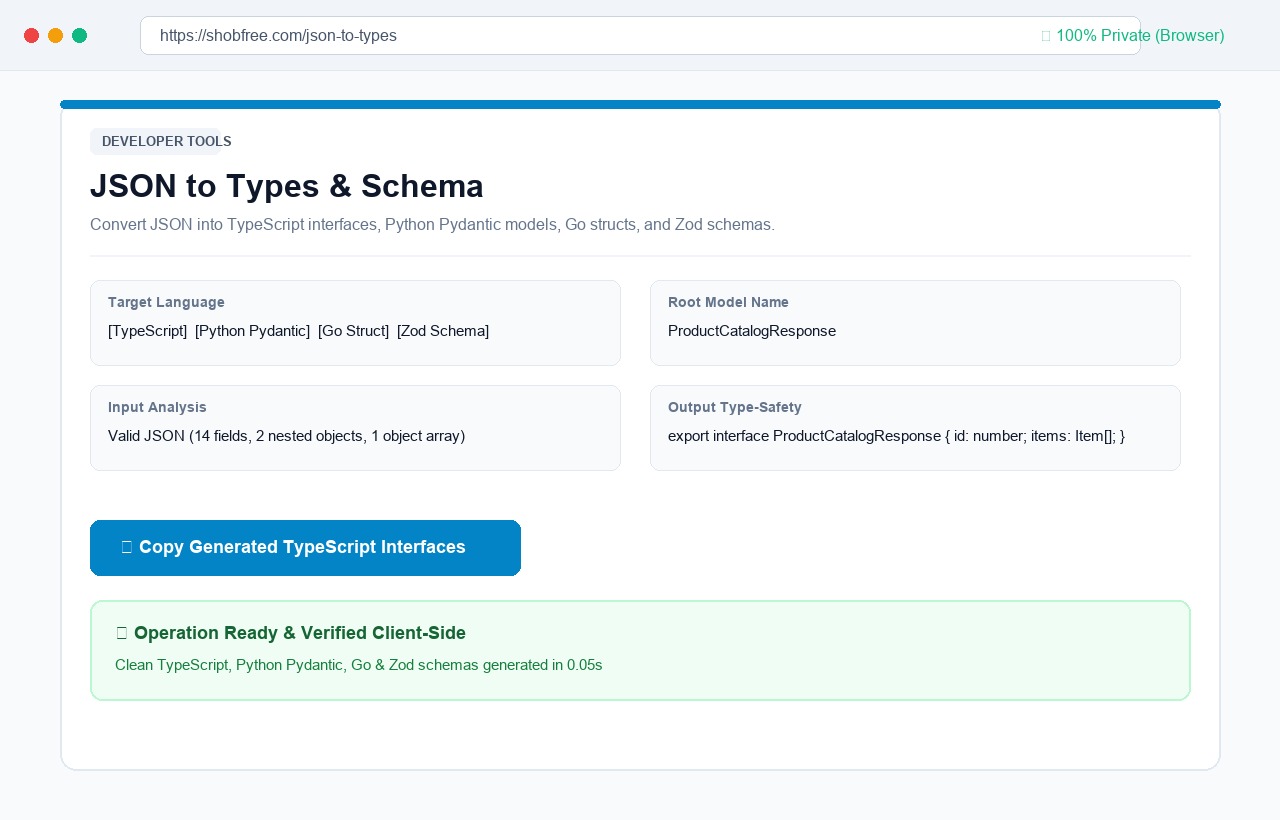 JSON to Types: paste any JSON payload, select TypeScript, Python Pydantic, Go, or Zod, and copy clean type declarations.
Frequently asked questions
Does it handle deeply nested objects and arrays? Yes. The parser recursively traverses nested objects and arrays of objects, generating clean, modular sub-models for every nested entity.
Is my private API or database data secure? Yes. Code generation is executed 100% client-side in your browser's JavaScript engine. Your JSON payloads are never transmitted to any external server.
Can I format messy JSON with the tool? Yes. Click the Format JSON button to beautify and indent your raw JSON with clean 2-space indentation before inspection.