What Is Waist-to-Hip Ratio and What Is a Healthy Number?
Learn how to measure your waist and hips, how to work out the ratio, the WHO risk limits for men and women and what to do with the result.

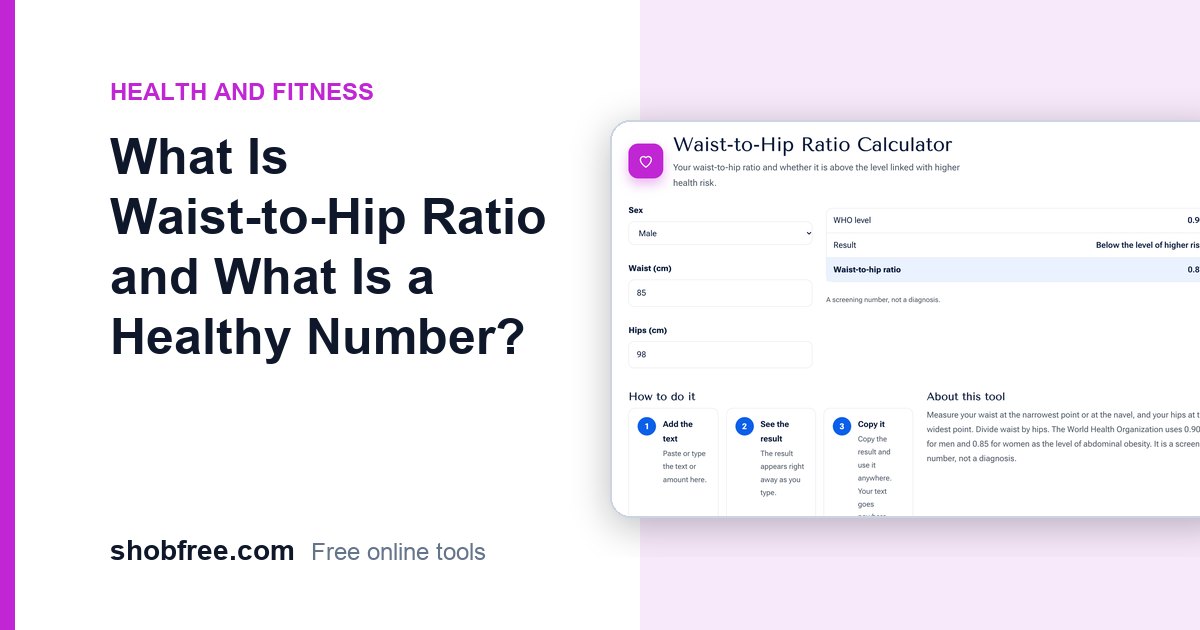
Weight and BMI do not show where your body stores fat. That matters, because fat carried around the waist is linked with a higher risk of heart disease and type 2 diabetes than fat carried on the hips and thighs. The waist-to-hip ratio is a simple measure of this, and you only need a tape measure. The free Waist-Hip Ratio Calculator does the division and shows the risk level.
Quick answer
Divide your waist measurement by your hip measurement. The World Health Organization describes abdominal obesity as a ratio of 0.90 or more for men and 0.85 or more for women. A man with an 85 cm waist and 98 cm hips has a ratio of 0.87, which is below the limit.
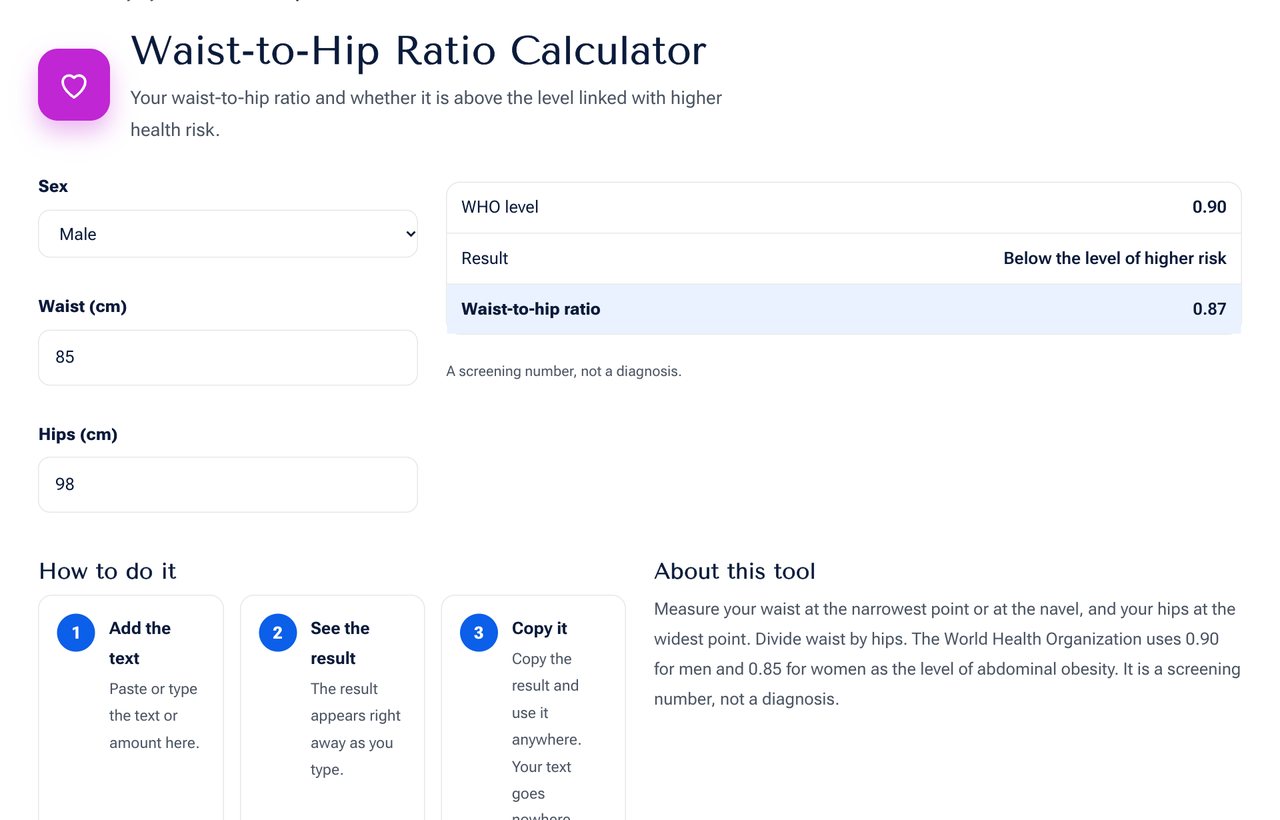 The Waist-Hip Ratio Calculator with a waist of 85 cm and hips of 98 cm.
How to measure correctly
- Stand upright with your feet together and breathe out normally.
- Measure your waist at the narrowest point, usually just above the navel. If there is no narrow point, measure halfway between the lowest rib and the top of the hip bone.
- Measure your hips at the widest part of the buttocks.
- Keep the tape level and snug, but not pressing the skin.
- Use the same units for both, centimetres or inches.
Take each measurement twice and use the average. Measure in the morning before eating for the most consistent results.
Reading the result
| Sex | Lower risk | Higher risk |
|---|---|---|
| Men | below 0.90 | 0.90 or more |
| Women | below 0.85 | 0.85 or more |
The WHO limits are population guides, not diagnoses. Someone just above the line is not necessarily ill, and someone just below is not guaranteed to be healthy.
Why it can be more useful than BMI
BMI uses only height and weight. A muscular person can have a high BMI with little fat, and a person with a normal BMI can still carry fat around the waist. The waist-hip ratio, along with the waist measurement itself, points to the type of fat that matters most for risk. Together they give a better picture. See also the BMI Calculator and the Body Fat Calculator.
Waist circumference on its own
Many guidelines also use waist size alone. A waist of 94 cm or more for men and 80 cm or more for women suggests increased risk, and 102 cm and 88 cm suggest a high risk, in European populations. South Asians tend to develop metabolic problems at lower waist sizes, so the lower figures are a prudent guide for people in Bangladesh.
How to improve your ratio
- Move daily. Brisk walking, cycling or swimming for 150 minutes a week is a good base.
- Add strength work two or three times a week.
- Eat more vegetables, lentils and whole grains, and cut down on sugary drinks and fried snacks.
- Sleep seven to eight hours and manage stress, which both affect belly fat.
- Aim for gradual change. Losing 5 to 10 percent of your weight can shrink the waist and improve blood sugar and blood pressure.
When to see a doctor
If your ratio is in the higher risk range, or you have a family history of diabetes or heart disease, ask your doctor about blood pressure, blood sugar and cholesterol checks. This guide is general information, not a diagnosis.
Sources and further reading
- World Health Organization, waist circumference and waist-hip ratio: who.int.
Frequently asked questions
Does the ratio apply to children? No. These limits are for adults. Children use growth charts.
How often should I measure? Every month is enough. Daily changes are mostly water and food.
Is a lower ratio always better? Very low values may reflect low body fat or muscle loss. Aim for the healthy range, not the smallest number.
Next step
Measure yourself and enter the numbers in the Waist-Hip Ratio Calculator.