How to Test Your Reaction Time and Improve It
Measure your reaction time in milliseconds, learn what a typical score is, what affects it and how sleep, practice and setup can improve it.

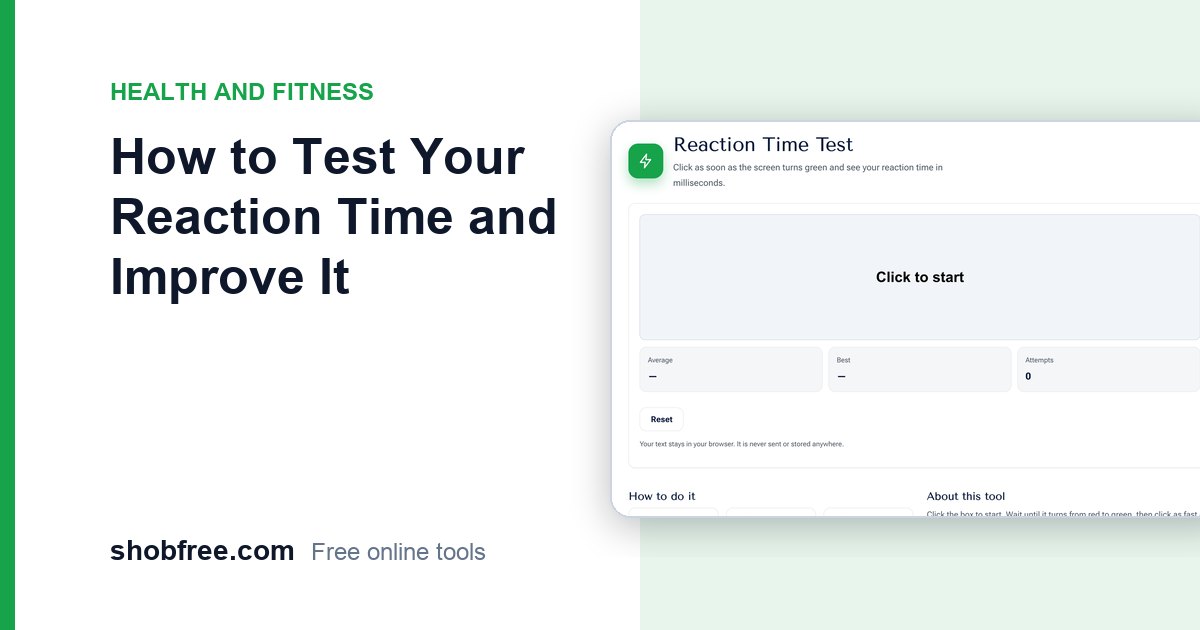
Reaction time is the gap between seeing something and responding to it. It matters in sport, driving, gaming and many jobs, and it is easy to measure. The free Reaction Time Test shows how many milliseconds you need to click after the screen turns green, and it keeps your average and best of the last ten tries.
Quick answer
Click the box to start, wait for it to turn from red to green, then click as fast as you can. If you click too early, the round restarts. A typical result is 200 to 300 milliseconds. Most people average around 250 ms in a simple visual test.
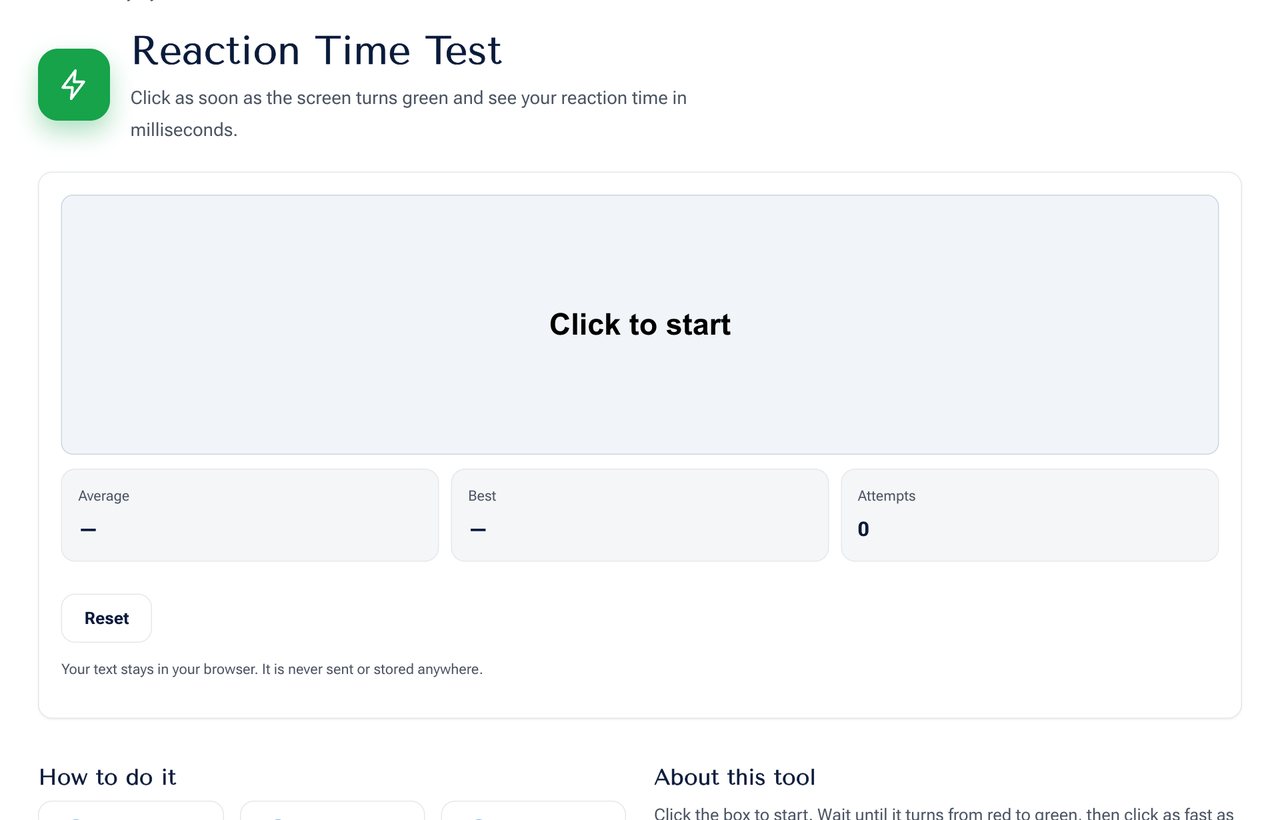 The Reaction Time Test showing a result in milliseconds with average and best times.
What is a good score?
| Time | What it suggests |
|---|---|
| Under 200 ms | Very fast, typical of trained players and athletes |
| 200 to 250 ms | Fast, above average |
| 250 to 300 ms | Average |
| 300 to 400 ms | Slower, often tiredness or a laggy setup |
| Above 400 ms | Distracted, very tired or a technical delay |
Your result includes the time your screen and mouse take to respond, so a gaming monitor and a wired mouse can make you look about 20 to 40 ms faster without changing your brain at all.
What affects reaction time
- Sleep. Short sleep slows reactions noticeably, in some studies as much as mild alcohol intoxication.
- Age. Reaction time is fastest in the twenties and slows gradually afterwards.
- Attention and stress. Distractions add delay.
- Caffeine can make reactions a little faster for some people.
- The device. Screen refresh rate, mouse or touch screen and network lag all add time.
- Practice. Repeating the same test improves the result for that test.
How to get a fair result
- Use the same device each time.
- Take at least five attempts, because a single try is noisy.
- Sit comfortably, and focus on the box only.
- Do not anticipate the colour. The random wait is designed to stop guessing.
- Compare your average, not your best single try.
How to improve
- Sleep seven to eight hours. It is the strongest effect.
- Exercise regularly. Cardio and sports that need quick decisions help.
- Practise a specific skill, such as a game or a sport drill, rather than only the test.
- Reduce distractions like notifications while you play or work.
- Keep hydrated and eat regular meals.
Brain-training games are often claimed to improve reaction time in general, but the evidence for broad transfer is limited. Specific practice improves the specific skill.
A note on safety
Reaction time is only one part of safe driving. If you feel sleepy, do not drive. Never use a test result to decide whether you are fit to drive or work with machinery.
Related tests
Try the Click Speed Test to measure clicks per second and the Typing Speed Test to measure words per minute.
Frequently asked questions
Why do I get different results each time? Reaction time varies from try to try by 20 to 50 ms, which is normal.
Is the timer accurate? It uses the browser's high-resolution clock, so it is accurate to a fraction of a millisecond, but your display and mouse add their own delay.
Does touch screen differ from mouse? Yes. Touch screens often add 50 to 100 ms.
Next step
Take the Reaction Time Test and try it again after a good night's sleep.