How to Find Your Target Heart Rate Zones for Exercise
Learn how to work out your maximum heart rate and training zones, with a simple method and a more personal one using resting heart rate.

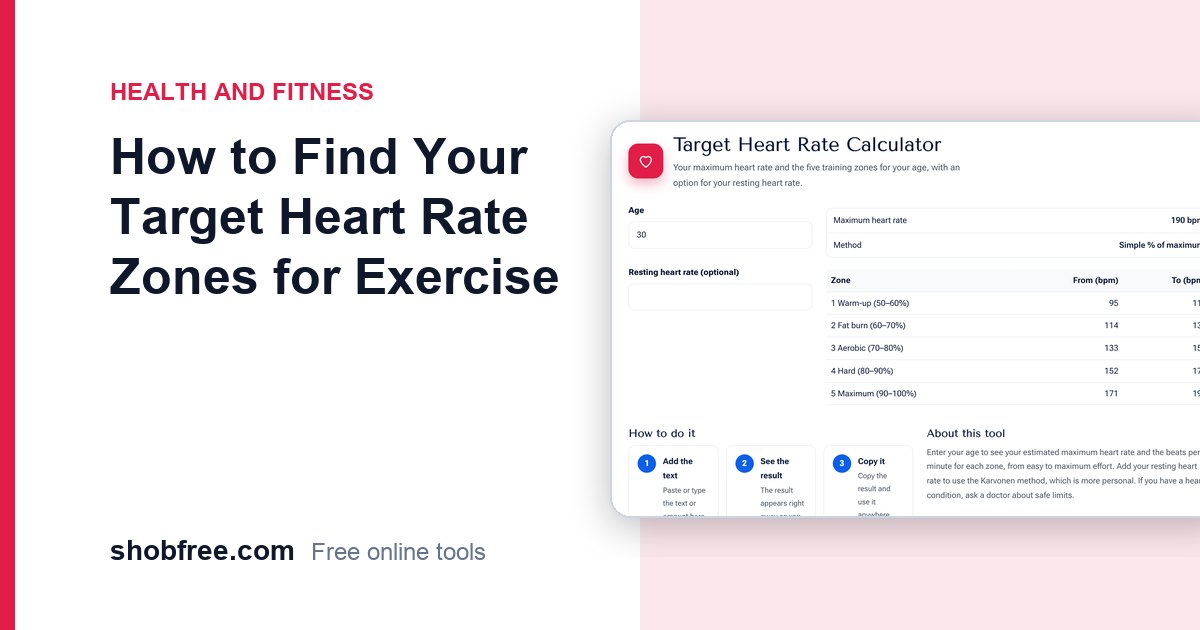
Training at the right heart rate helps you burn fat, build stamina or recover. The free Target Heart Rate Calculator lists the zones for your age.
Quick answer
Maximum heart rate is about 220 minus your age. A 30-year-old has a maximum of about 190 beats per minute. Moderate exercise is usually 50 to 70 percent of that, about 95 to 133 bpm.
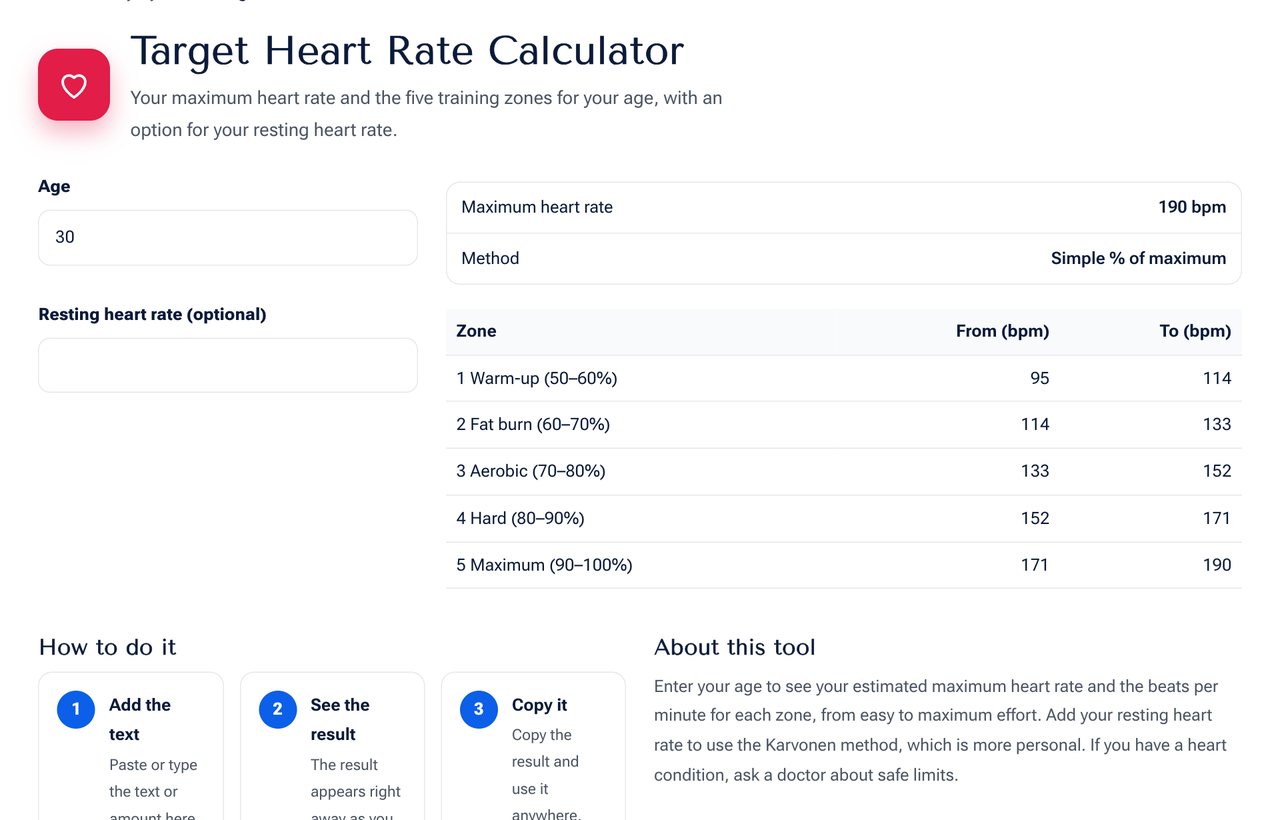 The Target Heart Rate Calculator tool on shobfree.com, ready to use in your browser.
The five zones
- 50 to 60 percent: very light, warm-up and recovery.
- 60 to 70 percent: light, builds basic endurance and burns fat.
- 70 to 80 percent: moderate, improves aerobic fitness.
- 80 to 90 percent: hard, raises speed and threshold.
- 90 to 100 percent: maximum effort, only for short bursts.
A more personal method
If you know your resting heart rate, the Karvonen method uses the reserve between resting and maximum. With a resting rate of 70 and a maximum of 190, the reserve is 120. Sixty percent of the reserve plus resting rate is 142 bpm.
How to measure your pulse
- Sit quietly for five minutes in the morning.
- Place two fingers on your wrist or neck.
- Count beats for 30 seconds and double it.
Tips
- Use zones as a guide. Breathing and how you feel matter too.
- Medicines, heat and stress can change heart rate.
- Increase intensity slowly, a little each week.
Which zone for which goal
For general health, aim for 150 minutes a week in zones 2 and 3. For fat loss, most of your sessions should stay in zone 2, with one or two harder sessions. For a faster 5 km, add short intervals in zone 4 with rests between. Zone 5 is only for a few minutes at a time and not for beginners.
Checking with the talk test
You do not need a watch. In zone 2 you can speak full sentences. In zone 3 you can speak in short phrases. In zone 4 you can say only a few words. If you cannot speak at all, you are in zone 5. This works well when a heart-rate reading is unreliable.
Resting heart rate as a fitness marker
A lower resting heart rate often goes with better cardiovascular fitness. Most adults sit between 60 and 100 beats a minute, and trained people can be in the 40s or 50s. A sudden rise of 10 beats or more over several days can be a sign of stress, illness or poor sleep, so it is useful to note it each morning.
Warm-up and cool-down
Spend five minutes in zone 1 before you push harder, and five minutes slowing down afterwards. This lets your heart rate rise and fall gradually and lowers the strain on your body.
Sources and further reading
- World Health Organization physical activity guidelines recommend at least 150 minutes of moderate activity a week for adults: who.int.
Frequently asked questions
Is 220 minus age accurate? It is an average and can be off by 10 beats or more for an individual.
Should I see a doctor first? Yes, if you have heart disease, chest pain or have not exercised for a long time.
Do medicines change the zones? Some, such as beta blockers, lower heart rate. Follow your doctor's advice instead of the calculator.
Next step
Enter your age in the Target Heart Rate Calculator. Track the effort of a workout with the Calories Burned Calculator.