How to Calculate Sales Commission and the Sales You Need to Hit a Target
Learn how a commission is worked out, how to find the sales needed for a target income, and how to compare commission plans with a worked example.

Whether you sell insurance, phones, property or your own products through an agent, commission is the link between effort and income. It is simple arithmetic, but it is easy to get wrong when a plan has a base salary or a target. The free Commission Calculator does it both ways: what you earn from a given sale, and what you must sell to reach an income.
Quick answer
Commission = sales amount x commission rate. Sales of 2,50,000 taka at 5 percent pay 12,500. To earn 20,000 at 5 percent you need sales of 4,00,000, which is the target divided by the rate.
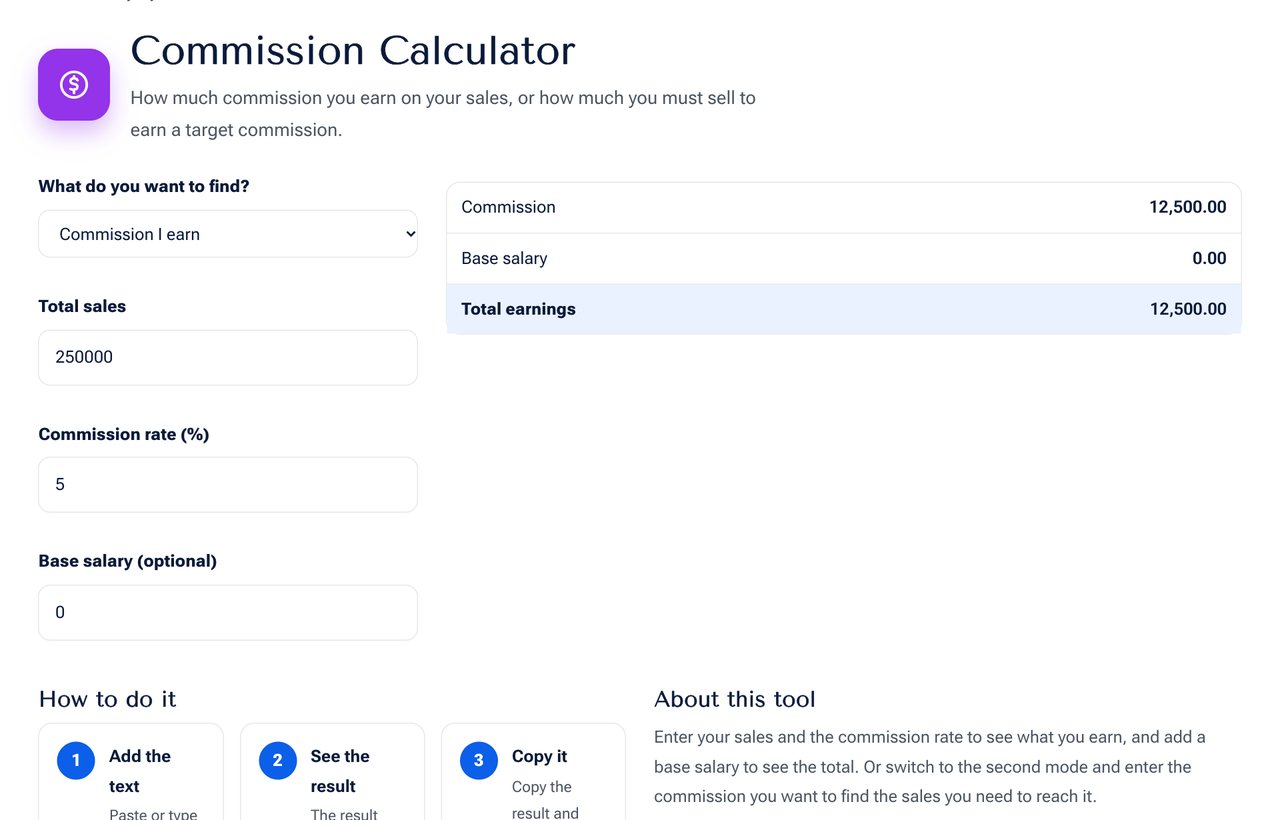 The Commission Calculator showing commission and total earnings.
The two questions it answers
- What will I earn? Enter the sales, the rate and an optional base salary. You get the commission and the total earnings.
- What must I sell? Choose "sales needed", enter the target income from commission and the rate, and read the sales required.
Worked examples
Earnings. A salesperson has a base salary of 15,000 and earns 5 percent on sales. In a month with sales of 2,50,000, commission is 12,500 and total earnings are 27,500.
Target. The same person wants 20,000 in commission. At 5 percent, sales must reach 4,00,000. At a rate of 4 percent the figure rises to 5,00,000, so a one-point change in rate needs a quarter more sales.
Common commission plans
| Plan | How it works | Good for |
|---|---|---|
| Straight commission | A percentage of every sale, no base | High-ticket, self-driven sales |
| Base plus commission | Fixed salary plus a lower percentage | Steady income with incentive |
| Tiered commission | The rate rises after a sales threshold | Rewarding top performers |
| Per-unit | A fixed amount for every item sold | Retail and distribution |
If your plan is tiered, calculate each slice at its own rate and add them together.
Commission on profit versus on sales
Some businesses pay on revenue and others on gross profit. A 5 percent commission on revenue can be much more expensive for the business than 20 percent on profit, because a heavily discounted sale still earns the full revenue commission. If you own the business, test both with your margins using the Margin and Markup Calculator.
Tips for salespeople
- Ask whether commission is paid on invoiced sales or on money actually collected.
- Find out how returns, cancellations and bad debts are treated.
- Check the timing: monthly, quarterly or after the customer pays.
- Keep your own record of every sale and its date.
Tips for owners
- Make the plan simple enough that a salesperson can calculate it in their head.
- Pay on something you can measure and audit.
- Review the plan if margins or costs change.
- Put the rules in writing before the period starts.
Frequently asked questions
Is commission taxed? Commission is income and is usually taxed like salary. Check the rules that apply to you.
Can the rate differ by product? Yes. Calculate each product separately and add the results.
What if a sale is returned? Most plans reverse the commission. Confirm this in your agreement.
Next step
Open the Commission Calculator to test a plan. To see your selling margin, use the Margin and Markup Calculator, and for a quick percentage the Percentage Calculator.