How to Find Your Break-Even Point (Formula and Example)
Find how many units you must sell to cover your costs. Learn the break-even formula with a simple shop example and tips to lower it.

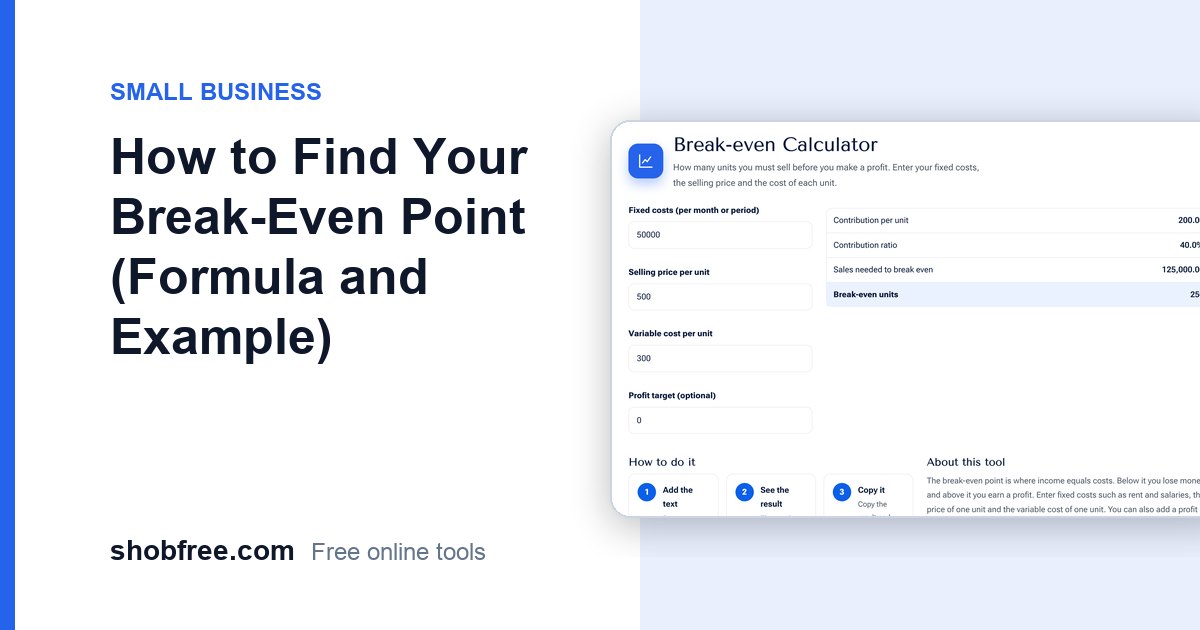
The break-even point is the number of items you must sell before you start making a profit. Every small business owner should know it. The free Break-Even Calculator works it out from three numbers.
Quick answer
Break-even units = fixed costs divided by (selling price minus variable cost per unit).
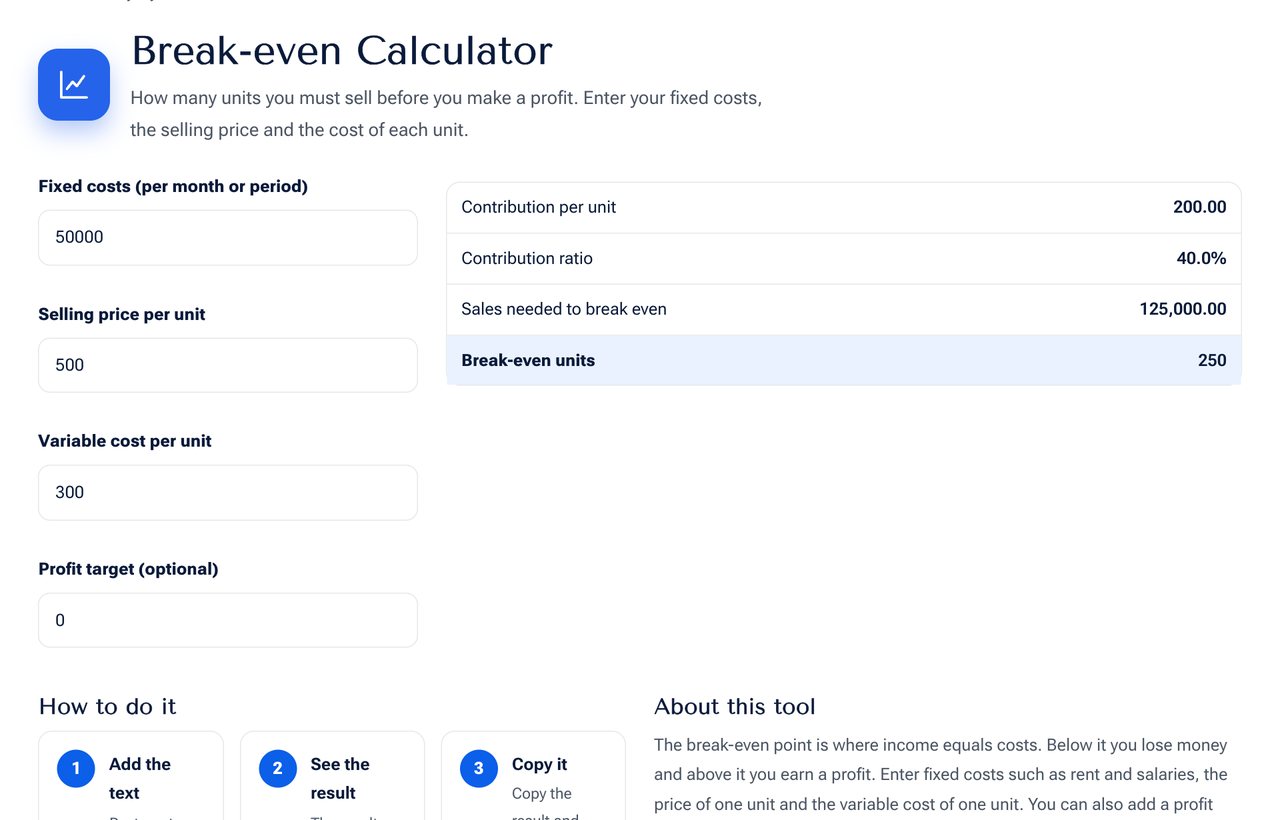 The Break-even Calculator tool on shobfree.com, ready to use in your browser.
A worked example
A small shop sells a product for 500 taka. Each item costs 300 taka to buy or make (variable cost). Monthly fixed costs, such as rent and salary, are 60,000.
- Profit on each item: 500 minus 300 = 200.
- Break-even units: 60,000 divided by 200 = 300 items a month.
- Break-even sales: 300 times 500 = 1,50,000 taka.
Sell fewer than 300 and you lose money. Every item above 300 adds 200 to profit.
Fixed and variable costs
- Fixed costs stay the same however much you sell: rent, salaries, licences, internet.
- Variable costs rise with each sale: materials, packaging, delivery, commission.
If you are unsure where a cost belongs, ask whether it goes away when you sell nothing.
How to lower the break-even point
- Raise the price, if customers will accept it.
- Reduce variable cost by buying in larger amounts.
- Cut fixed costs, such as a cheaper location.
- Improve the product mix towards items with a higher profit per unit.
Using break-even to set a sales target
Break-even is a floor, not a goal. If you want to earn 30,000 a month on top of costs, add it to the fixed costs: (60,000 + 30,000) divided by 200 = 450 items a month. This turns a vague hope into a daily target. At 26 selling days that is about 17 items a day.
Checking a price change
Try a 10 percent discount. The price becomes 450, so each item earns only 150. Break-even rises from 300 to 400 items. A discount that looks small can force you to sell a third more just to stand still, so test it before you offer one.
Break-even for a service business
A freelancer has fixed costs of 25,000 a month for rent, internet and software. If the average project earns 8,000 and costs 1,000 in direct expenses, each project contributes 7,000. Break-even is 25,000 divided by 7,000, which is about 3.6, so four projects a month are needed before a taka of profit appears. Knowing this shows how many clients to find before you quit a job.
Break-even and cash flow
Break-even tells you about profit, not about cash. If customers pay after 60 days, you can be profitable on paper and still run out of money. Keep a small cash reserve and track when payments arrive, not only what is sold.
Sources and further reading
- For pricing and margins, use the Margin and Markup Calculator.
Frequently asked questions
What if I sell several products? Use an average price and cost, or calculate each product with its share of fixed costs.
Does break-even include my own salary? It should. Otherwise the business may look profitable while paying you nothing.
How often should I recalculate? Whenever rent, wages, supplier prices or your selling price change, and at least every quarter.
Next step
Enter your costs in the Break-Even Calculator. Then check your margins with the Margin and Markup Calculator.