How to Build a Habit Tracker You Will Actually Use (Free Printable)
Make a simple monthly habit tracker, choose habits that stick, use the research on habit formation and print a free A4 sheet in your browser.

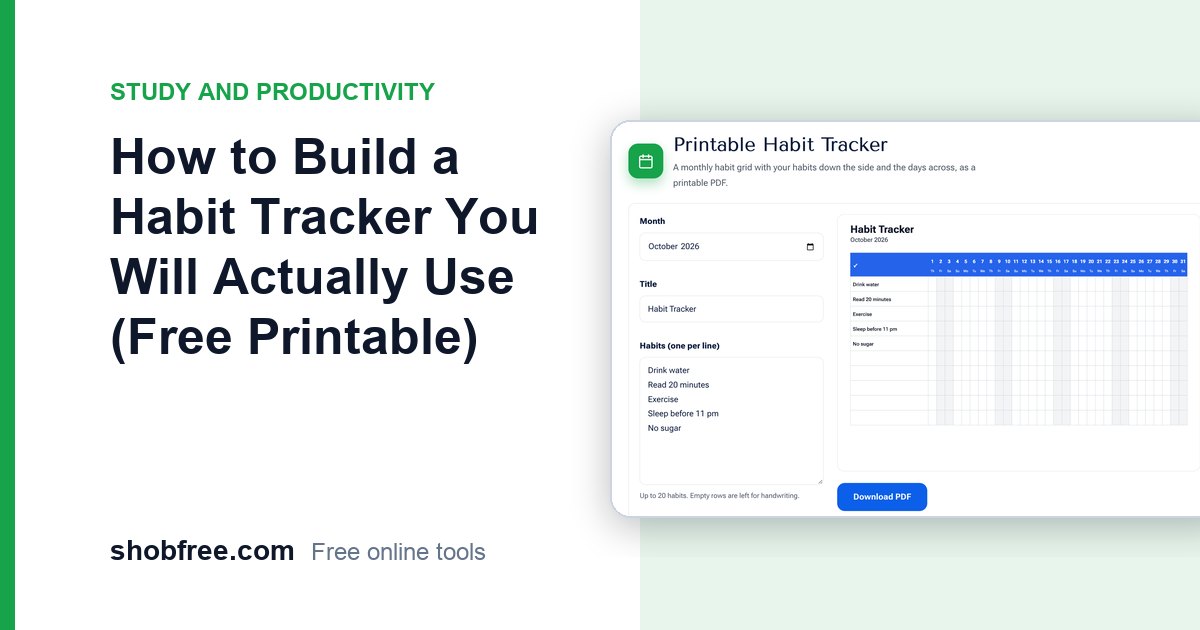
Most people do not fail at habits because they lack willpower. They fail because the habit is too big, too vague or invisible. A simple tracker makes the habit visible every day. The free Habit Tracker creates a printable monthly grid with your own habits, ready to print on A4 paper.
Quick answer
Choose the month, type your habits one per line, pick a colour and download the PDF. Print it, stick it where you see it daily and tick a box each day you do the habit.
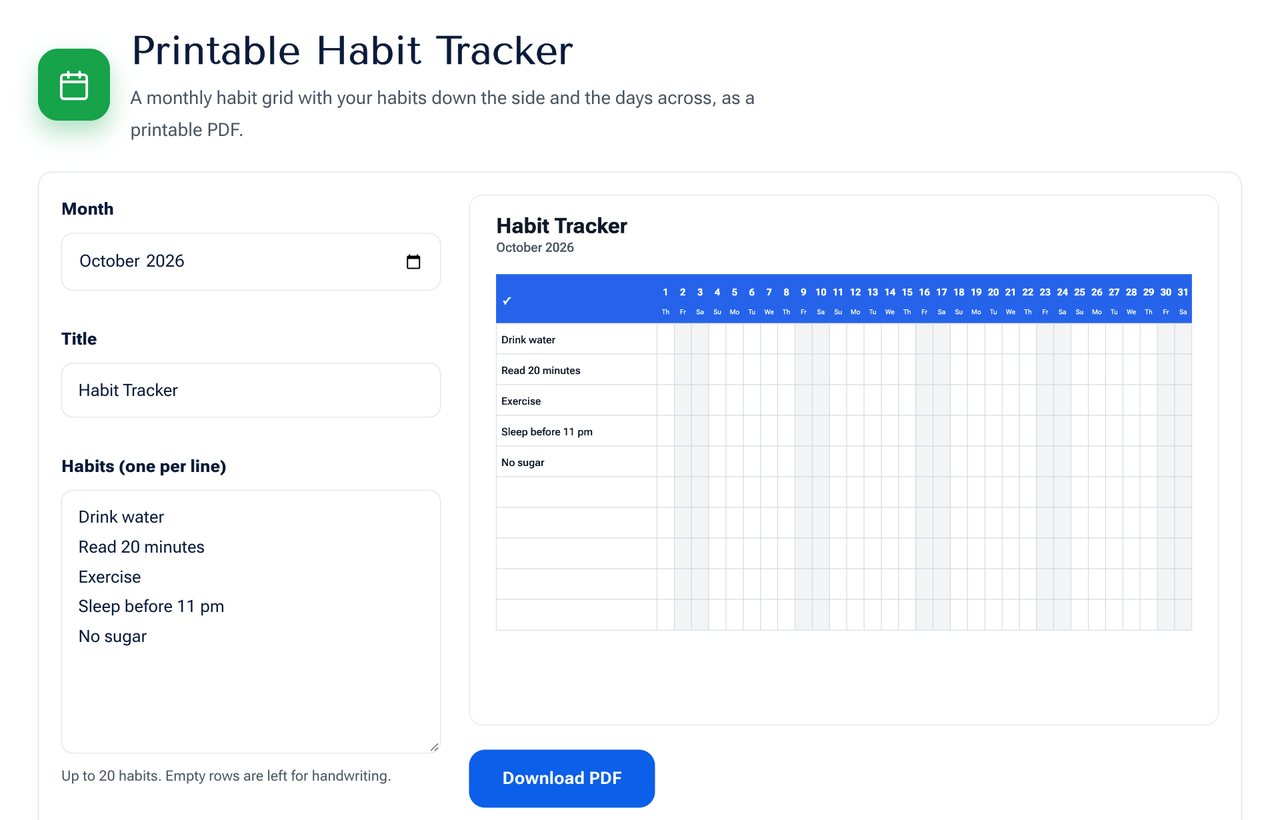 The Habit Tracker with a monthly grid of habits and days.
Why tracking helps
A tracker does three things. It reminds you of the habit each day. It gives a small reward when you tick the box. And it shows your pattern, so you see what helped on good weeks and what got in the way on bad ones. Missing one day is not a failure. Missing two in a row is the point to restart.
How long does a habit take?
A well-known study from University College London followed people building a new daily habit and found that it took an average of 66 days for the behaviour to become automatic, with a range from 18 to 254 days depending on the person and the habit. Missing a single day did not ruin the process. So plan for a couple of months, not three weeks.
Choose habits that stick
- Start small. "Walk for 10 minutes" survives a bad day. "Run for an hour" does not.
- Be specific. "Read 10 pages after dinner" is better than "read more".
- Limit yourself to three to five habits at first. The tracker allows up to 20, but fewer works better.
- Attach it to something you already do. "After morning tea, I write three lines in my diary."
- Make it easy to start. Put the book on the pillow and the water bottle on the desk.
Examples of habits to track
| Area | Example habit |
|---|---|
| Health | Drink 8 glasses of water, 30-minute walk, sleep before 11 pm |
| Learning | Read 10 pages, 20 minutes of English practice |
| Money | Note the day's expenses, no impulse purchases |
| Mind | 5 minutes of quiet breathing, write in a journal |
| Home | Make the bed, tidy for 10 minutes |
How to use the printed sheet
- Print the page and put it on the fridge, the study table or the wall by the bed.
- Keep a pen next to it.
- Tick or colour the box straight after the habit, not at night from memory.
- At the end of the week, count your ticks and note what to change.
- At the end of the month, keep the sheet and make a new one with adjusted habits.
Make it work when life gets busy
- Have a minimum version of each habit, such as two minutes, for a bad day.
- Never miss twice. One miss is life, and two start a new pattern.
- Plan for travel and holidays by choosing which habits pause.
- Celebrate progress, for example a small treat after a full week.
Pair it with a plan
For study and work habits, combine the tracker with the Pomodoro technique and a weekly plan from the Weekly Planner. To track your water, use the Water Intake Calculator.
Sources and further reading
- Lally P. and others, "How are habits formed: Modelling habit formation in the real world", European Journal of Social Psychology, 2010.
Frequently asked questions
Can I print it on Letter paper? Yes. Use fit-to-page in the print window.
How many habits fit? Up to twenty rows, plus empty rows for writing by hand.
Why are weekends shaded? So that you can see the weekly pattern at a glance.
Next step
Make your tracker with the Habit Tracker and start today.