How to Read a Loan Amortization Schedule (With an Example)
See how each loan payment is split between interest and principal, and how the balance falls month by month, using a worked example.

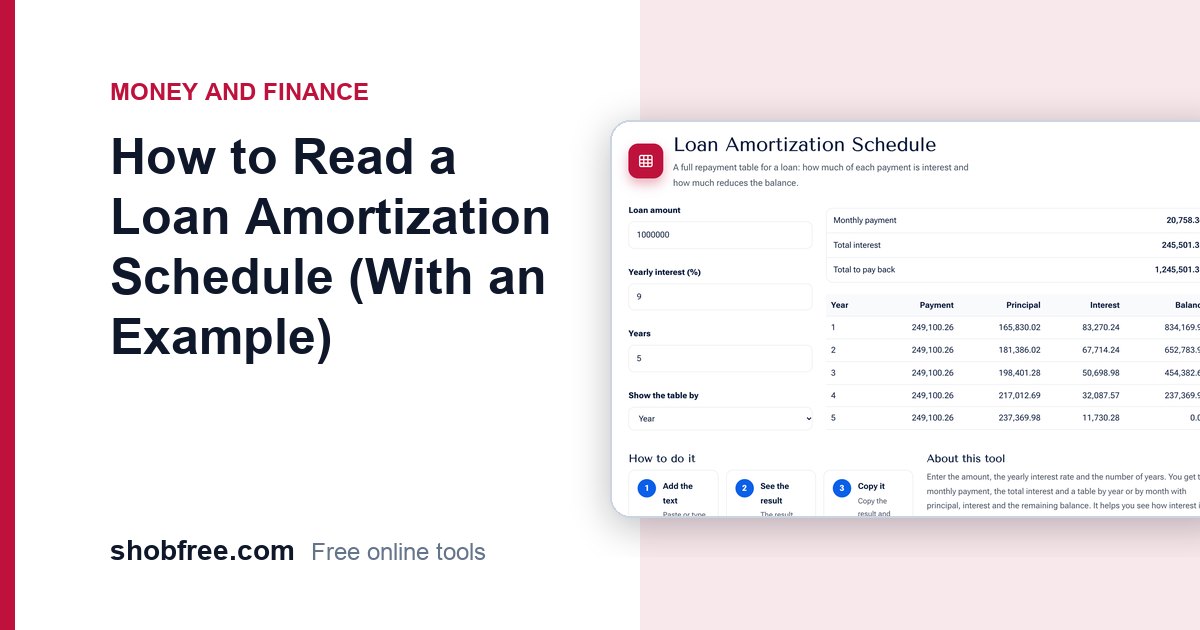
A loan amortization schedule is a table that shows every payment you will make, and how much of it goes to interest and how much repays the loan. It is the best way to see what a loan really costs. The free Loan Amortization Schedule builds the table in seconds.
Quick answer
Enter the amount, the yearly interest rate and the number of months. The schedule lists each month with the payment, the interest part, the principal part and the balance left.
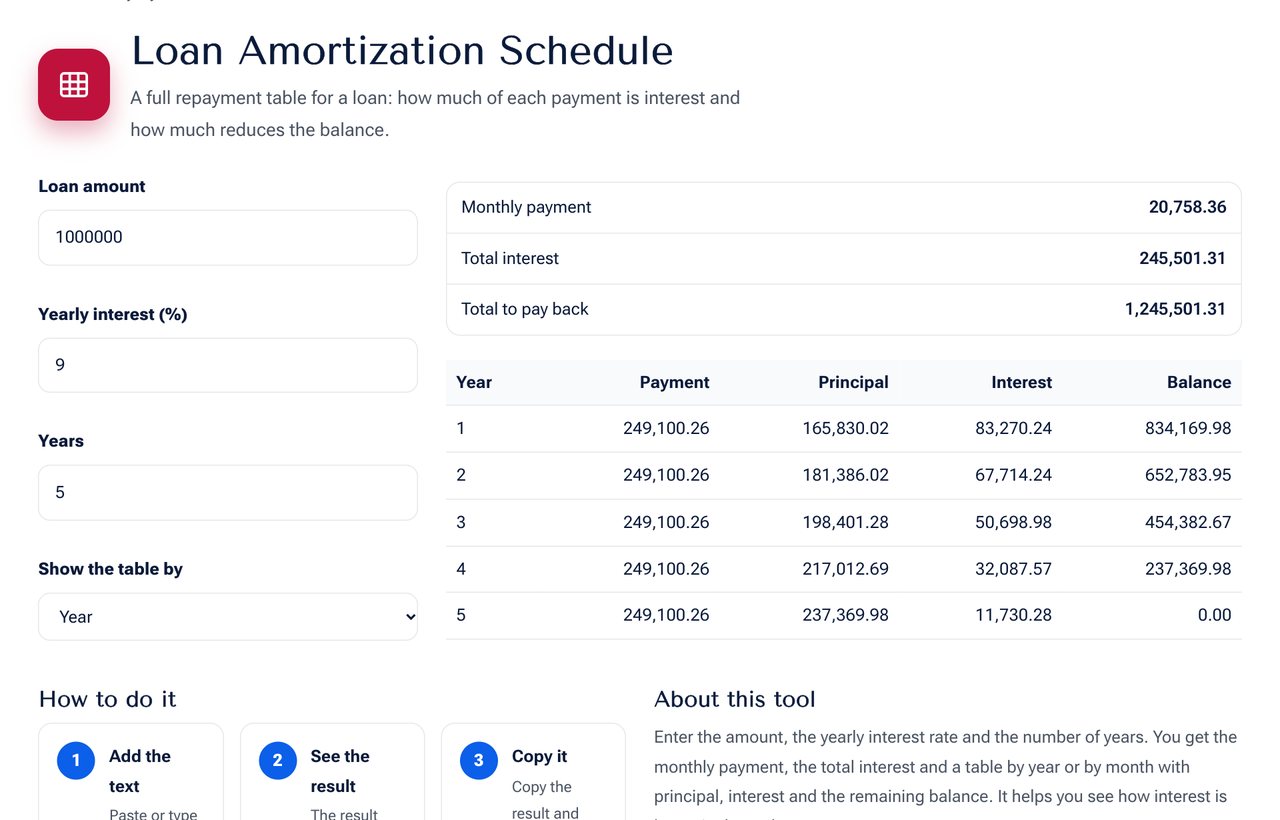 The Loan Amortization Schedule tool on shobfree.com, ready to use in your browser.
A worked example
Take a loan of 10,00,000 taka at 10 percent a year for 5 years. The monthly payment is about 21,247. In the first month the interest is 8,333 (one twelfth of 10 percent of the full amount), so only about 12,914 reduces the loan. In the last month almost all of the payment is principal.
Over the five years you pay about 12,74,800 in total, which means roughly 2,74,800 is interest.
How to read the columns
- Payment: the same amount every month.
- Interest: the balance at the start of the month multiplied by the monthly rate.
- Principal: payment minus interest. This part grows every month.
- Balance: what you still owe after that payment.
Why the early months matter
Interest is charged on the balance, which is highest at the start. That is why paying extra in the first years saves the most. An extra payment goes entirely to principal, so every later month has less interest.
Tips
- Compare a shorter and a longer term. A shorter term has a higher payment but much less interest.
- Look at the balance after year 1. It is often higher than people expect.
- Check whether your lender charges fees for early repayment before paying extra.
What happens if you pay extra
Suppose you add 5,000 taka to the same 21,247 payment every month. That whole 5,000 is principal, so the balance falls faster and each later month has less interest. A loan that would have taken 60 months may finish in about 46, and you save tens of thousands of taka in interest. Always ask the lender how extra payments are applied: some reduce the term, others only lower the next payments.
Comparing offers
When two banks quote different rates, do not compare the rate alone. Compare the total paid at the end of the schedule, including processing fees and insurance. A slightly lower rate with a high fee can cost more than a higher rate with none. Put the same amount and term into the schedule for each offer and look at the last row.
Three habits that save money on any loan
- Pay on the due date, not after. Late payment fees and penalty interest are charged on top of the schedule and do not reduce the balance.
- Make one extra payment a year. A thirteenth payment, from a bonus for example, shortens a five-year loan by several months.
- Check the statement against the schedule. If the balance on your statement is higher than the schedule says, ask the bank to explain the difference in writing.
Reading the totals at the bottom
The last rows of the schedule show total payments and total interest. Divide the total interest by the loan amount to get the cost of borrowing as a share of the loan. In the example this is about 27 percent over five years. Compare that figure between offers, since it includes the effect of the term and the rate together.
Sources and further reading
- For consumer credit principles, see the guidance of Bangladesh Bank.
Frequently asked questions
Is the schedule the same as the bank's? It should be close. Banks may round differently or calculate interest by the day.
Can I use it for a car or home loan? Yes. Any loan with a fixed rate and equal payments works.
Why does the interest part fall every month? Interest is charged on the remaining balance. As the balance falls, so does the interest, while the fixed payment sends more to principal.
Next step
Open the Loan Amortization Schedule, enter your numbers and see the full table. For a quick payment figure only, use the Loan Calculator.