How to Check Keyword Density and Word Frequency in Your Content
Find your most repeated words and phrases, learn what keyword density means, and why natural writing beats chasing a fixed percentage for SEO.

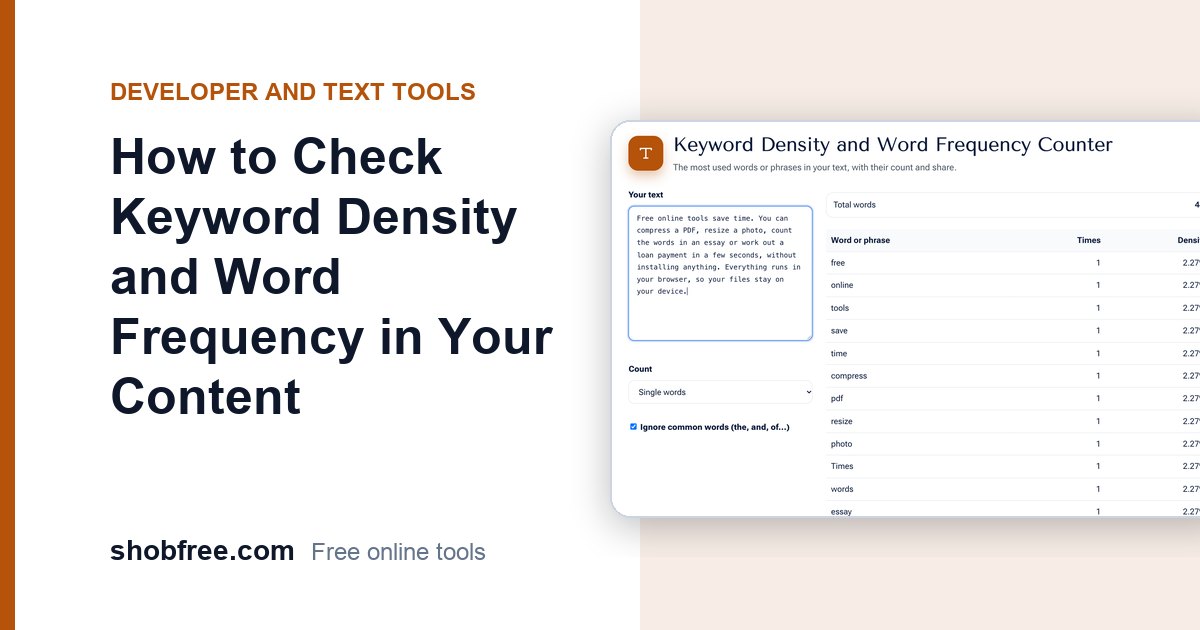
Keyword density is one of the oldest SEO ideas, and also one of the most misunderstood. A quick check of which words you repeat can still help you edit better, as long as you do not chase a number. The free Keyword Density Counter lists your most frequent words, two-word and three-word phrases, with counts and percentages.
Quick answer
Keyword density is the number of times a word or phrase appears divided by the total number of words, as a percentage. A keyword used 12 times in a 1,000-word article has a density of 1.2 percent. There is no ideal percentage, and Google does not use a fixed target.
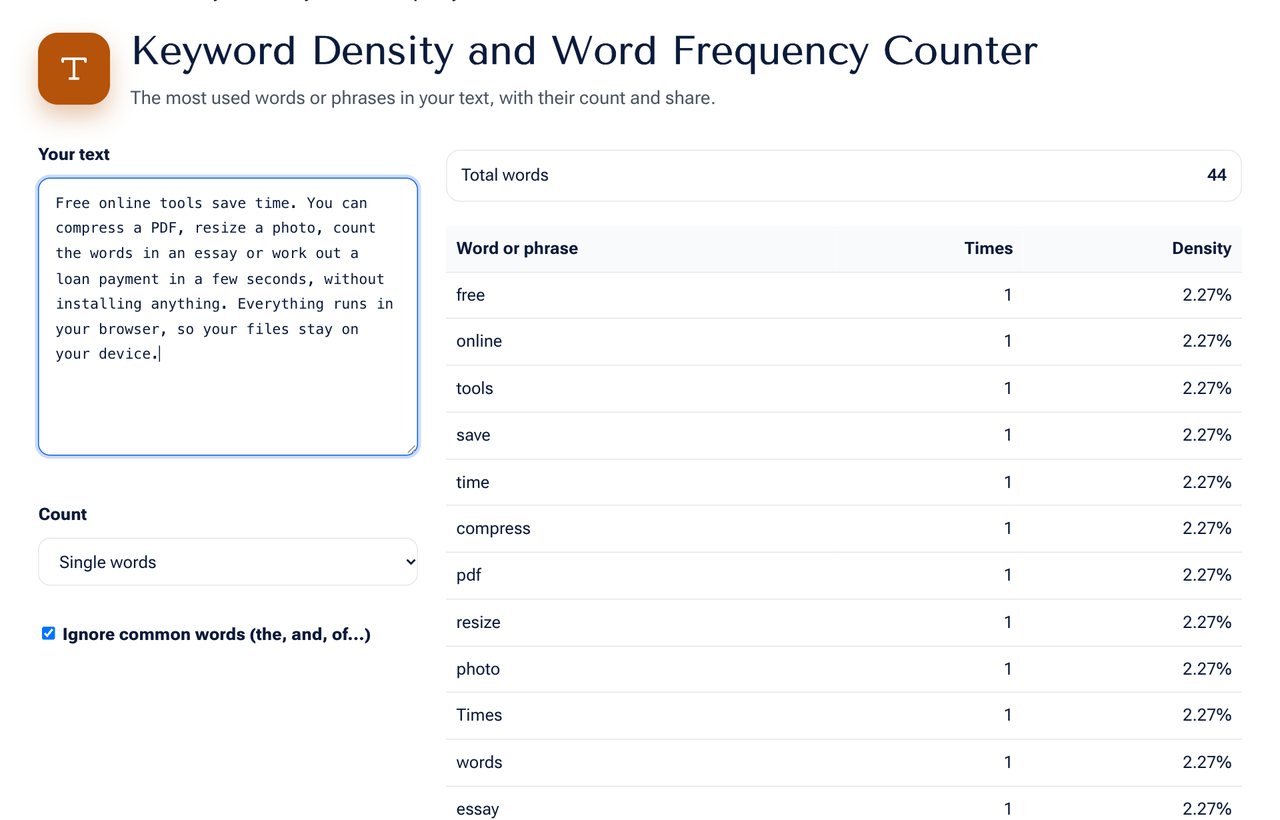 The Keyword Density Counter showing the most used words and their share.
What the tool shows
- The most frequent single words, with common stop words such as "the" and "and" removed on request.
- The most frequent two-word and three-word phrases, which are closer to what people search for.
- The count and the percentage of the whole text for each.
- The total number of words.
What Google actually says
Google's guidance is to write naturally for people. Repeating a phrase unnaturally, known as keyword stuffing, is against its spam policies and can harm a page. Modern search systems understand synonyms and meaning, so a good page uses the main phrase where it fits and also related words.
How to use the check sensibly
- Look for accidental overuse. If your most repeated word is not your topic, something is off. If one word appears 40 times in 800 words, read the text aloud and see if it sounds forced.
- Look for gaps. If the topic phrase appears only once, the page may not be clearly about it. Use it in the title, the first paragraph and a heading where it is natural.
- Check related terms. The two-word and three-word lists show the phrases you actually used. Add related terms that readers may search for.
- Compare with a top-ranking page to see which subtopics it covers, without copying its words.
Where to place the main keyword
- The page title and the main heading (H1).
- The first 100 words.
- One or two subheadings, where it reads naturally.
- The URL slug, kept short. See How to Create SEO-Friendly URL Slugs.
- The image alt text, when the image shows the topic.
- The meta description, to help the click. See How to Write Meta Tags for SEO.
Signs of keyword stuffing
- The same phrase in every sentence.
- Lists of cities or product names with no purpose.
- Hidden text or text the same colour as the background.
- A sentence that no one would say in speech.
Beyond density
Helpful, accurate content that answers the reader's question, a clear structure, fast loading and trustworthy authorship matter far more. Use this tool as a proofreading aid, then read the page as a visitor would.
Frequently asked questions
What density should I aim for? There is no target. In ordinary natural writing, a main phrase often falls between 0.5 and 2 percent.
Does it count Bangla words? Yes, words are split on spaces and punctuation, so Bangla text works.
Do stop words matter? They are removed on request so that the list shows the meaningful words.
Next step
Paste your draft into the Keyword Density Counter. Then check the reading level with the Readability Score Checker.