How to Calculate Running Pace and Predict Your 5K, 10K and Marathon Time
Turn a distance and time into pace per kilometre and mile, speed, and projected finish times for 5K, 10K, half marathon and marathon.

Pace is the language of running: how long each kilometre takes. Knowing it lets you plan a race, set training zones and see real progress. The free Running Pace Calculator converts any distance and time into pace and speed, and projects finish times for the common race distances.
Quick answer
Pace = time divided by distance. Running 5 km in 30 minutes is 6 minutes per kilometre, which is about 9 minutes 39 seconds per mile and a speed of 10 km/h.
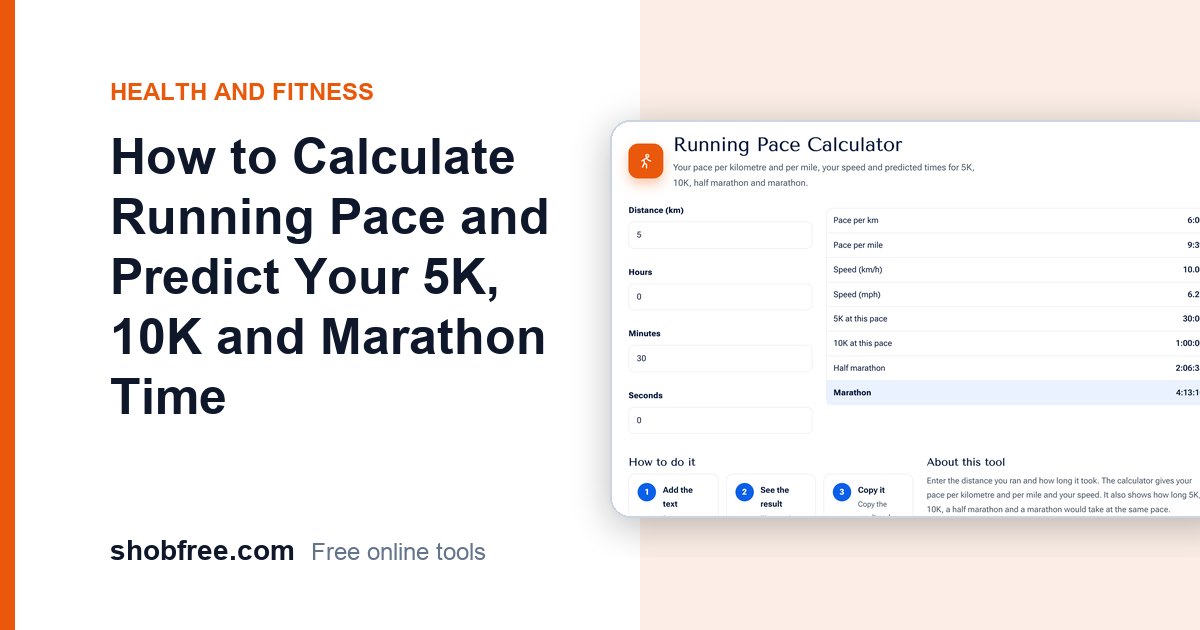
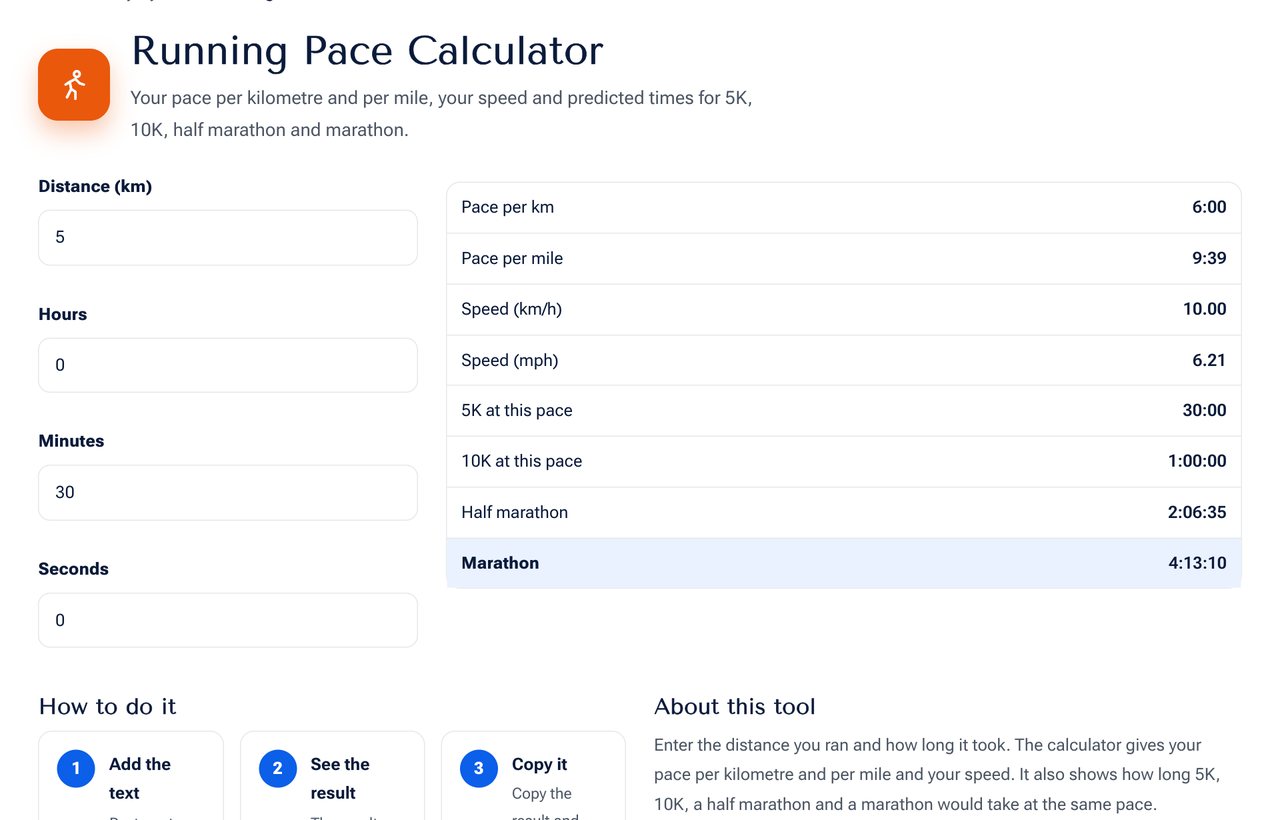 The Running Pace Calculator with a 5 km in 30 minutes run entered.
What the calculator shows
For a 5 km run in 30:00 you get:
| Result | Value |
|---|---|
| Pace per kilometre | 6:00 |
| Pace per mile | 9:39 |
| Speed | 10 km/h |
| 10K at the same pace | 1:00:00 |
| Half marathon | 2:06:35 |
| Marathon | 4:13:10 |
These are straight projections. They assume you can hold the same pace for the longer distance, which is rarely true without training.
How to use pace in training
- Easy runs should feel conversational. This is usually 60 to 90 seconds per kilometre slower than your 5K race pace.
- Tempo runs are comfortably hard, close to your 10K pace, for 20 to 30 minutes.
- Intervals are short repeats at or faster than 5K pace with rests between.
- Long runs are slow and steady, to build endurance for longer races.
Use your heart rate zones together with pace. The Target Heart Rate Calculator helps you set them.
Why projections are optimistic
A marathon time projected from a 5K is almost always too fast. Fatigue, fuelling and muscle damage make later kilometres slower. As a rough guide, runners who have trained properly add about 10 to 20 percent to the straight projection for a marathon, and 3 to 5 percent for a half marathon. Beginners should add more.
Race-day pacing
- Start slightly slower than goal pace for the first kilometre.
- Run even or slightly negative splits, with the second half equal to or faster than the first.
- Take water in warm weather. In Bangladesh's heat and humidity, plan for slower paces than in cool conditions.
- Do not try new shoes, food or kit on race day.
Pace versus speed
Treadmills show speed in km/h, while watches show pace in minutes per kilometre. To convert, divide 60 by the speed. 10 km/h is 6 minutes per kilometre. 12 km/h is 5 minutes. The calculator shows both so you can set a treadmill correctly.
Staying safe
Build mileage gradually, by no more than about 10 percent a week. Rest when you are in pain and see a doctor for chest pain, dizziness or breathlessness that is out of proportion. This guide is general information, not medical advice.
Frequently asked questions
What is a good 5K time? For beginners, 30 to 35 minutes is a solid start. Regular runners often finish in 22 to 28 minutes.
How can I improve my pace? Run consistently, include one faster session a week, add strength work and sleep well.
Should I run by pace or by feel? Use both. Pace gives a target and feel tells you whether it is sensible today.
Next step
Enter your latest run in the Running Pace Calculator. Estimate the energy you used with the Calories Burned Calculator.