How Much Protein Do You Need Per Day? A Simple Guide
Find your daily protein target based on body weight and activity, with examples for everyday life, strength training and weight loss.

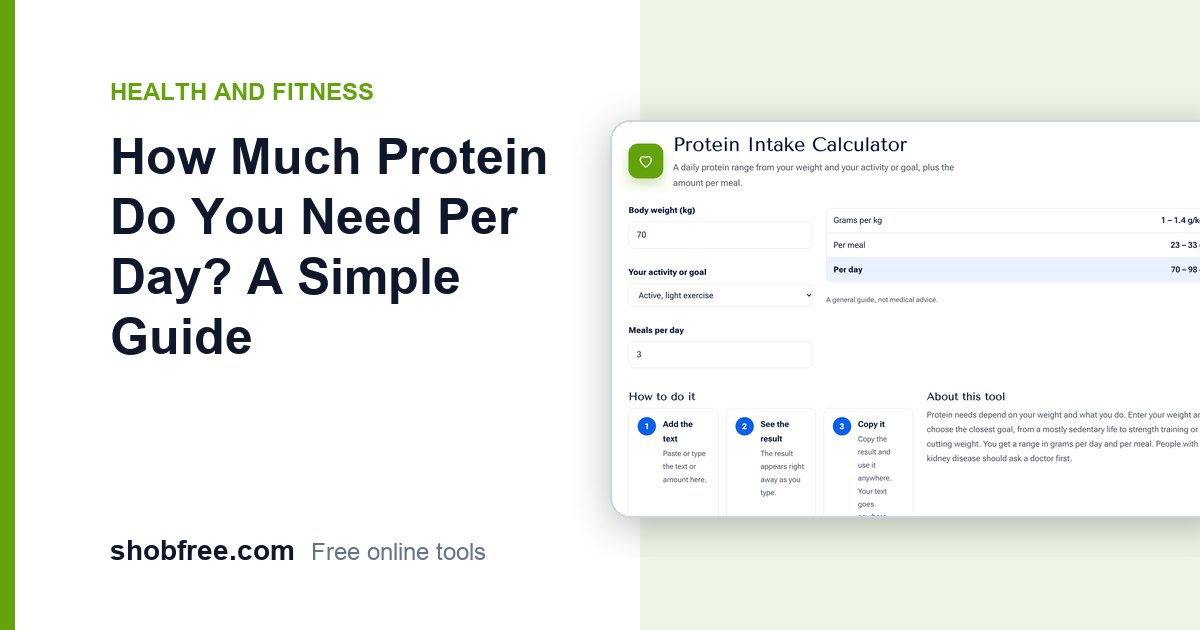
Protein repairs muscle and keeps you full. How much you need depends on your weight and how active you are. The free Protein Intake Calculator gives a daily range and a per-meal amount.
Quick answer
Most adults need at least 0.8 grams of protein per kilogram of body weight. Active people and those who train for strength need more, often 1.6 to 2.2 grams per kilogram.
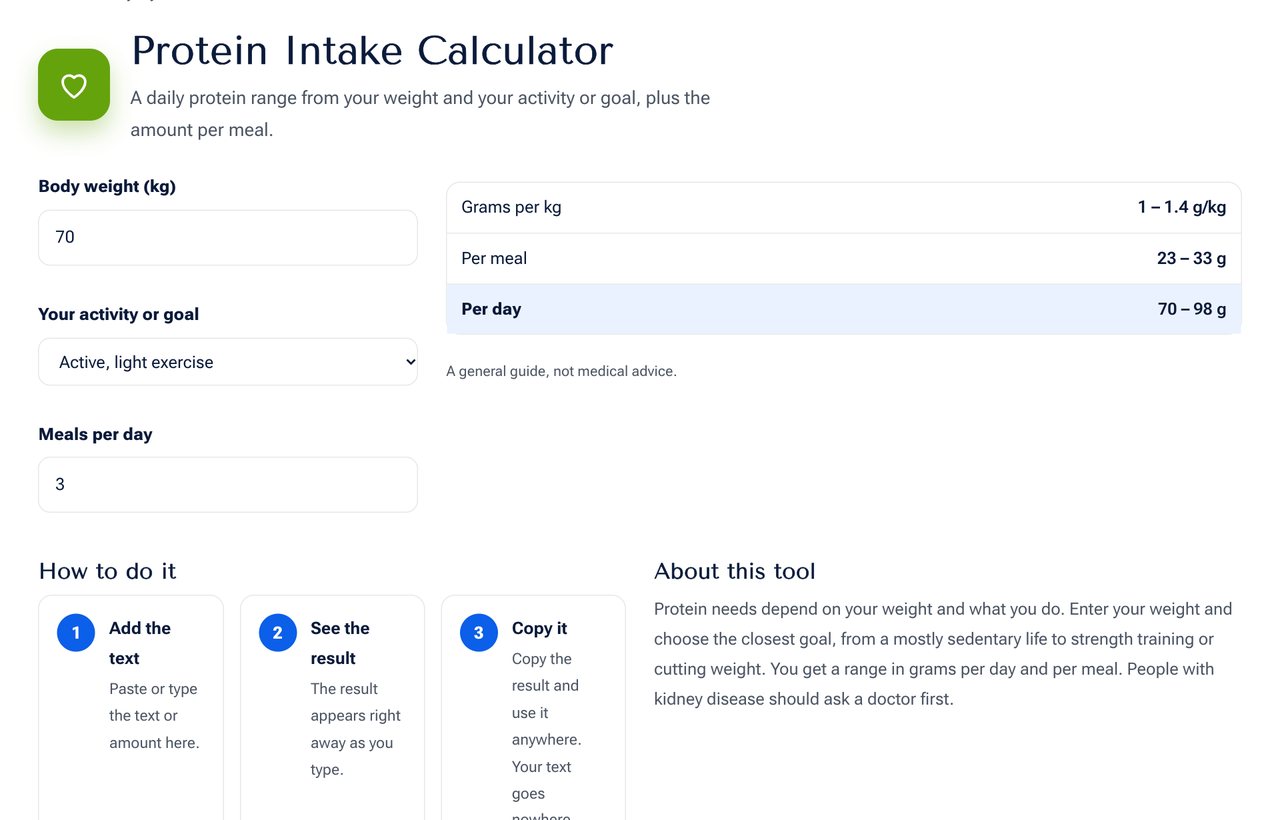 The Protein Intake Calculator tool on shobfree.com, ready to use in your browser.
A worked example
For a person weighing 70 kg:
- Mostly sitting: 0.8 to 1 g/kg, about 56 to 70 g a day.
- Active, regular exercise: 1 to 1.4 g/kg, about 70 to 98 g.
- Strength training: 1.6 to 2.2 g/kg, about 112 to 154 g.
- Fat loss with training: 1.8 to 2.4 g/kg, to help keep muscle.
Spreading it through the day
Dividing the total into three or four meals works better than one large serving. For 100 g a day over three meals, that is about 33 g each.
Good everyday sources
Eggs, fish, chicken, lentils (dal), chickpeas, milk, yoghurt, paneer and soya. A mix of plant and animal sources works well.
Tips
- Build each meal around a protein source.
- Choose protein-rich snacks such as eggs or yoghurt.
- Drink enough water, especially with higher protein.
- Do not rely on powders if food can do the job.
Who should be careful?
People with kidney disease and those on medical diets should ask their doctor before raising protein.
A sample day at about 100 grams
Breakfast of two eggs and a glass of milk gives about 19 g. A lunch of a palm-sized piece of fish or chicken with dal gives about 35 g. An evening snack of yoghurt or a handful of chickpeas gives about 10 g. Dinner with lentils, vegetables and an egg or chicken adds about 30 g. Together that is close to 100 g without any supplement.
For vegetarians
Combine lentils, beans, chickpeas, soya, nuts, milk and eggs through the day. Rice with dal together supplies a good range of amino acids. Vegetarians who exercise hard may aim for the upper end of their range, since plant proteins are slightly less digestible.
Protein for older adults
Muscle loss speeds up with age, and many guidelines suggest that adults over 65 aim for about 1.0 to 1.2 g/kg a day, at the higher end of the baseline range, along with resistance exercise. A 60 kg person would aim for 60 to 72 g. Spreading protein across meals helps absorption.
Reading labels
A 100 g serving of cooked chicken breast has roughly 30 g of protein, 100 g of cooked lentils about 9 g, an egg about 6 g and 100 g of paneer about 18 g. Values vary by brand and cooking, so use the label on packaged foods.
Sources and further reading
- World Health Organization and FAO reports on protein and amino acid requirements are the basis of the 0.8 g/kg reference value.
Frequently asked questions
Can too much protein harm me? For healthy people, moderate high intakes are generally tolerated, but extreme amounts add no benefit.
Do I need it right after exercise? The total across the day matters more than exact timing.
Is more protein better for weight loss? Higher protein keeps you full and protects muscle, but total calories still decide weight.
Next step
Enter your weight in the Protein Intake Calculator. Pair it with the Calorie Calculator.