How to Calculate ROI and Annualised Return
Learn the ROI formula, why time matters, and how to turn a total return into a yearly rate so you can compare investments fairly.

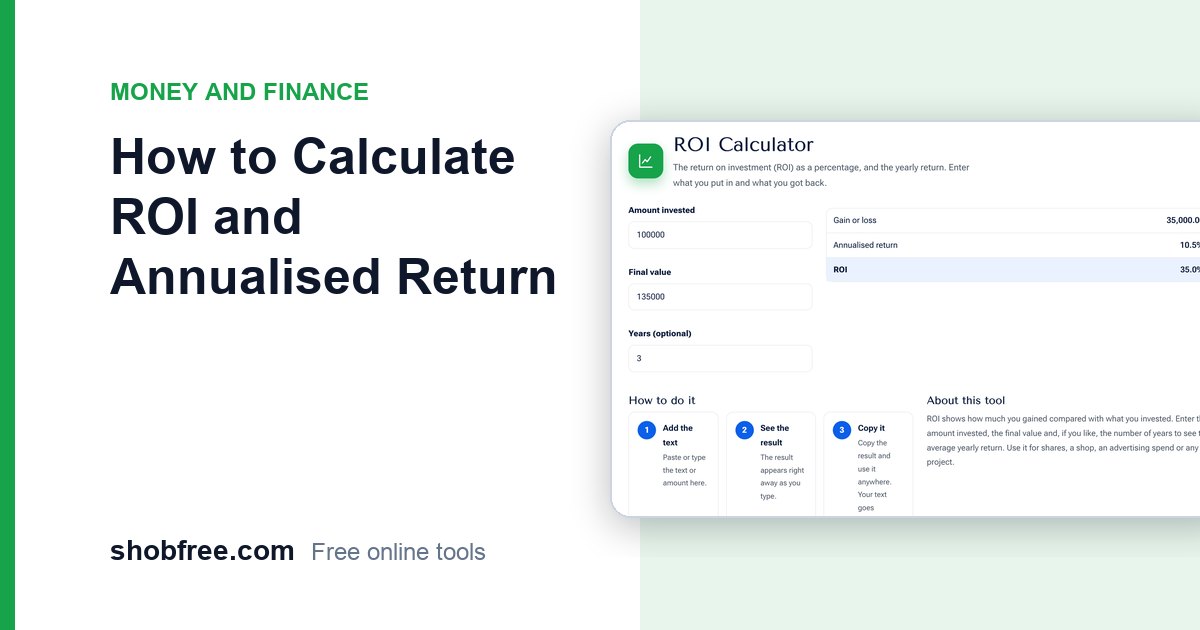
Return on investment, or ROI, tells you how much you gained compared with what you put in. It is simple, but it can mislead if you ignore time. The free ROI Calculator gives both the total ROI and the yearly rate.
Quick answer
ROI = (final value minus amount invested) divided by amount invested, shown as a percentage. For a gain of 50,000 on 2,00,000, ROI is 25 percent.
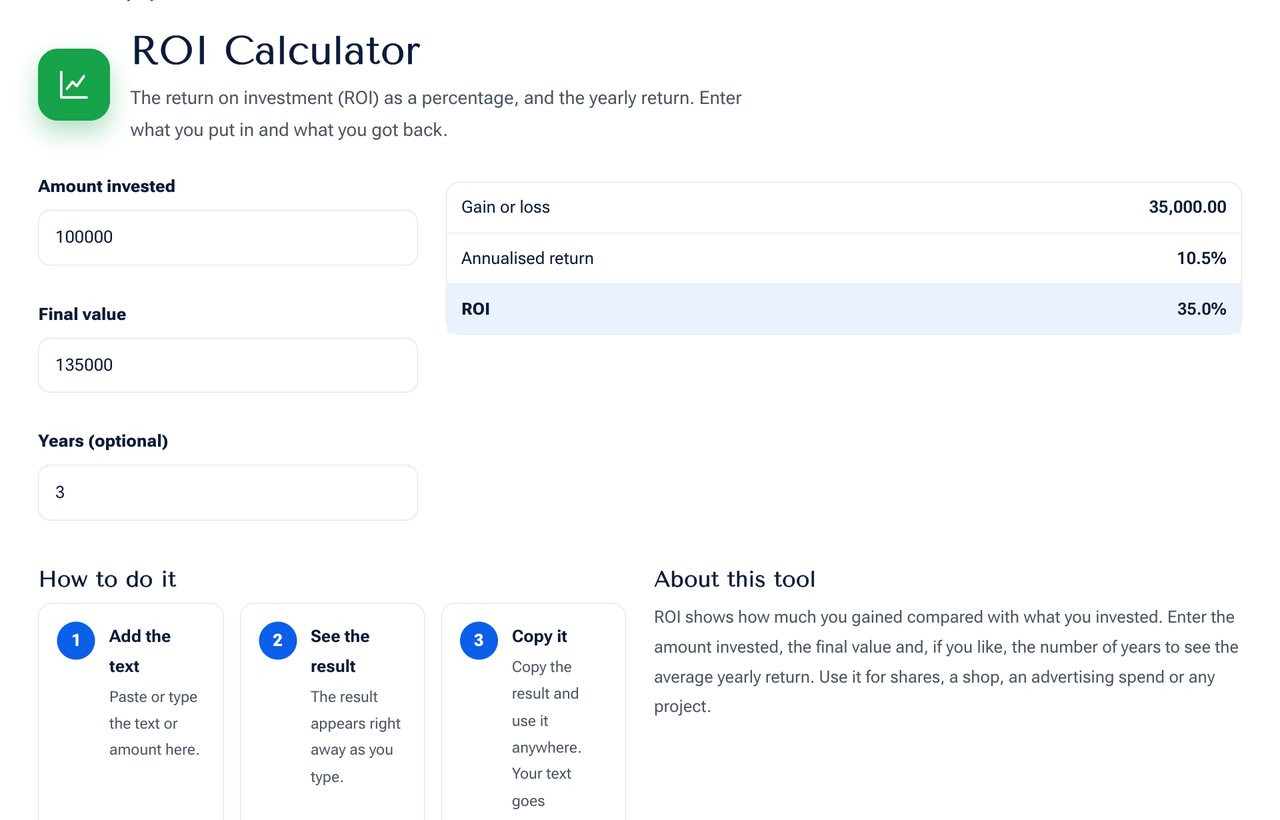 The ROI Calculator tool on shobfree.com, ready to use in your browser.
Why time changes the story
An ROI of 25 percent after two years is not the same as 25 percent after ten years. To compare them, convert to an annualised return:
annualised = (1 + ROI) to the power of (1 divided by years) minus 1.
For 25 percent over 2 years the yearly return is about 11.8 percent. The same 25 percent over 5 years is only about 4.6 percent a year.
How to use the calculator
- Enter the amount you invested.
- Enter the final value, including any money received along the way.
- Enter the number of years.
- Read the total ROI, the profit and the yearly return.
What ROI does not show
- Risk: two investments with the same ROI can have very different risk.
- Fees and tax: subtract them from the final value for a real figure.
- Inflation: if prices rose 6 percent a year, an 8 percent return is only about 2 percent in real terms.
Comparing two investments fairly
Suppose investment A returns 40 percent in 4 years and investment B returns 30 percent in 2 years. A looks bigger, but A's yearly return is about 8.8 percent, while B's is about 14 percent. B is the better use of money and time. Always convert to a yearly figure before comparing.
Include every cost
For a fair ROI, subtract all costs from the final value: purchase fees, transaction charges, maintenance, tax and any loan interest. A business owner should also count the time spent. A property that gains 10 percent but costs 4 percent a year to hold is not really earning 10 percent.
ROI in a small business
A shop owner spends 50,000 taka on a new freezer that adds 6,000 a month in profit. Annual gain is 72,000, so the first-year ROI is 144 percent, and the payback time is about 8 months. A figure like this helps you rank ideas. Compare it with another use of the same money, such as buying more stock that earns 4,000 a month at a cost of 80,000.
Pitfalls
- Counting revenue as gain. Use profit, after the cost of goods and running costs.
- Ignoring the time value of money. A taka today is worth more than a taka in five years, which is what the annualised return corrects.
- Using one lucky year. Look at several years before you trust an average.
Sources and further reading
- To compare lump sums and regular investments, see How Compound Interest Works.
Frequently asked questions
Can ROI be negative? Yes. A final value below the amount invested gives a negative ROI.
Is a high ROI always good? Not if it came with high risk or took a very long time.
Is ROI the same as profit? No. Profit is an amount of money. ROI is that profit as a share of what you invested.
Next step
Open the ROI Calculator and test an investment you are considering. You can compare it with a regular plan using the Compound Interest Calculator.